
Saint Jean de Brébeuf was a remarkable figure whose life was dedicated to his deep love for Christ and his unwavering zeal for spreading the Christian faith. Born on March 25, 1593, in Normandy, France, Brébeuf joined the Society of Jesus in 1617 and was ordained as a priest in 1622. His journey of faith and mission took him across the Atlantic to New France, now known as Canada, where he devoted his life to spreading the Gospel among the Huron people.
A Missionary's Devotion
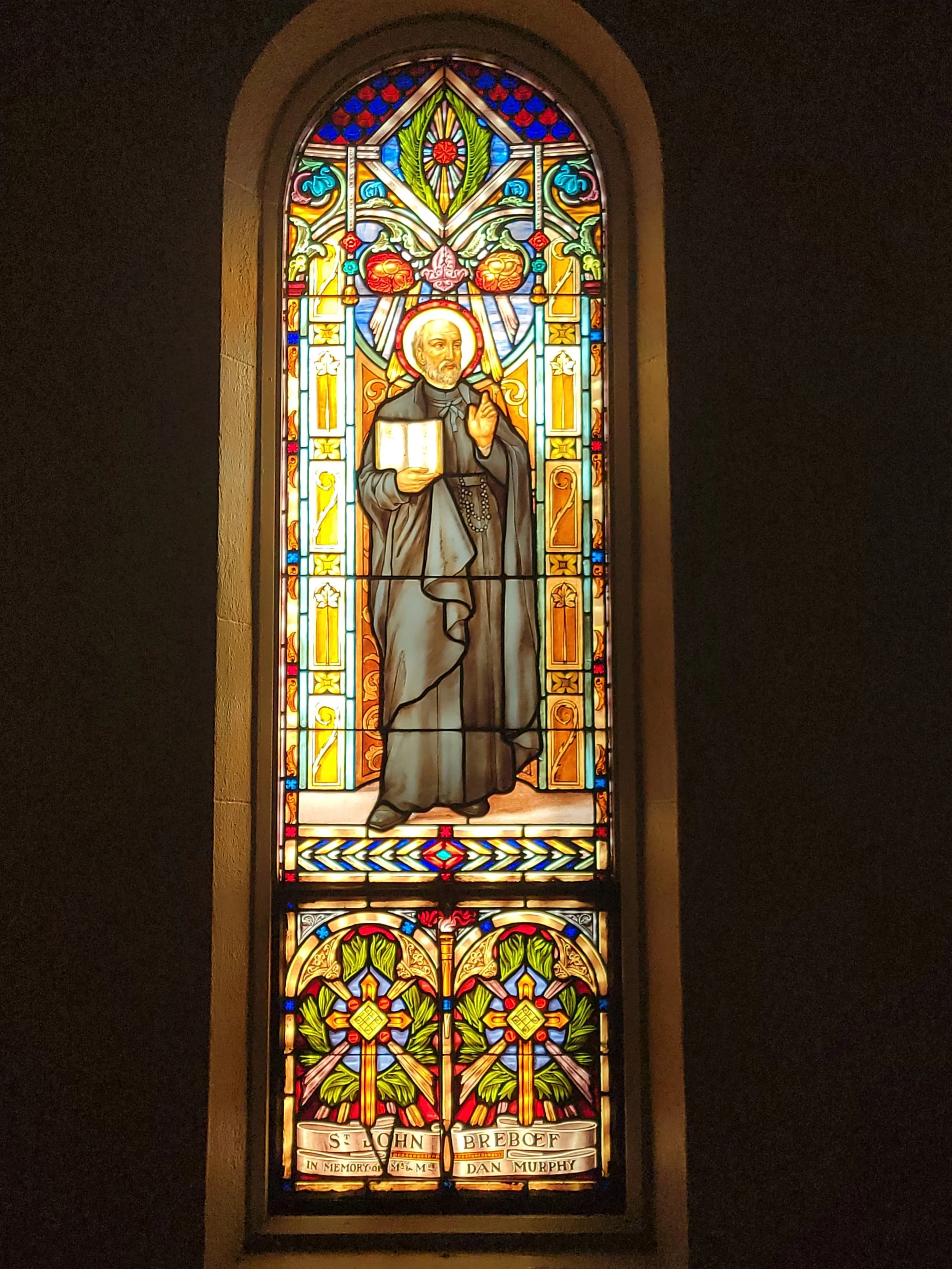
A stained glass window honouring St. Jean de Brebeuf in our church lobby.
Brébeuf's mission in New France began in 1625, where upon crossing the ocean and setting foot on foreign soil, he faced the formidable challenges of harsh winters and vast cultural differences. Despite these obstacles, he immersed himself in the Huron community, learning their language and customs. His genuine respect for the Huron and their way of life earned him their trust and friendship. Brébeuf's dedication was evident in his work to establish missions and his efforts in translating religious texts into the Huron language, making the teachings of Christianity accessible to them.
One of his most enduring contributions was the composition of the "Huron Carol," a Christmas hymn that beautifully blended Christian themes with Huron culture. This hymn remains a cherished part of Canadian Christmas traditions today. Brébeuf's work was instrumental in spreading Christianity throughout the region, and he became a respected figure not only among his fellow missionaries but also within the Indigenous communities.
Zeal for Faith Amidst Persecution
Brébeuf's unwavering love for Christ and his commitment to his mission were put to the ultimate test in 1649. Amid increasing tensions with the Iroquois, who were in conflict with the Huron, Brébeuf was captured during an attack on the mission of Saint-Louis. What followed was a testament to his extraordinary faith and courage.
He endured severe and brutal torture at the hands of his captors, including being scalped, doused in boiling water as a mockery of baptism, and having chunks of his flesh torn off. Despite the unimaginable pain, Brébeuf remained steadfast in his love for Christ, refusing to renounce his faith. His resilience and undying devotion to God left a profound impression on those who witnessed his martyrdom, both allies and adversaries alike. After his death, his body was buried at Sainte-Marie among the Hurons, a site of pilgrimage for thousands each year. His bones were later exhumed as relics, which now travel around the world and are venerated by many.
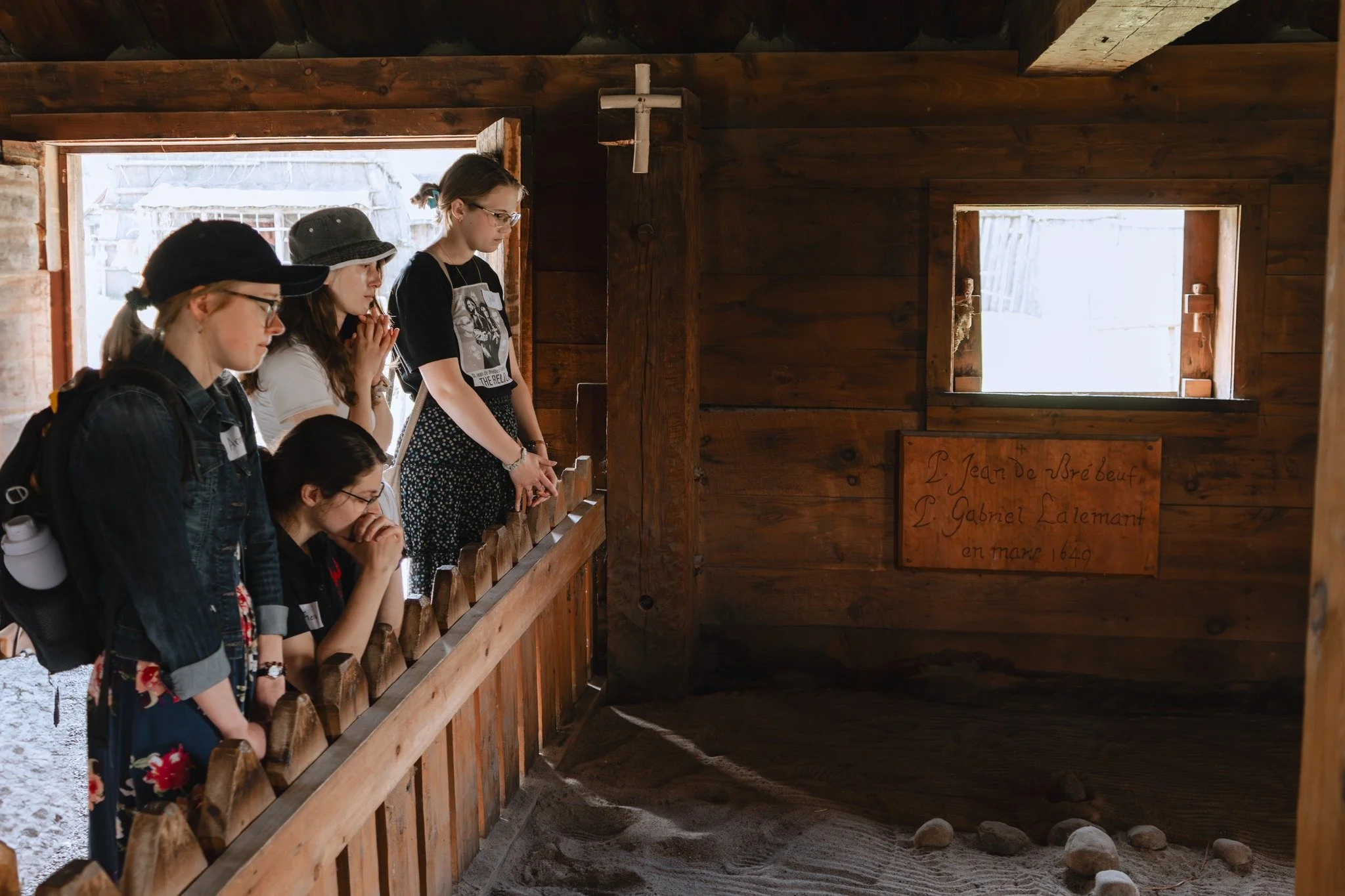
The burial site of Sts Jean de Brebeuf and Gabriel Lalemant. Photo: Canadian Martyrs’ Shrine.
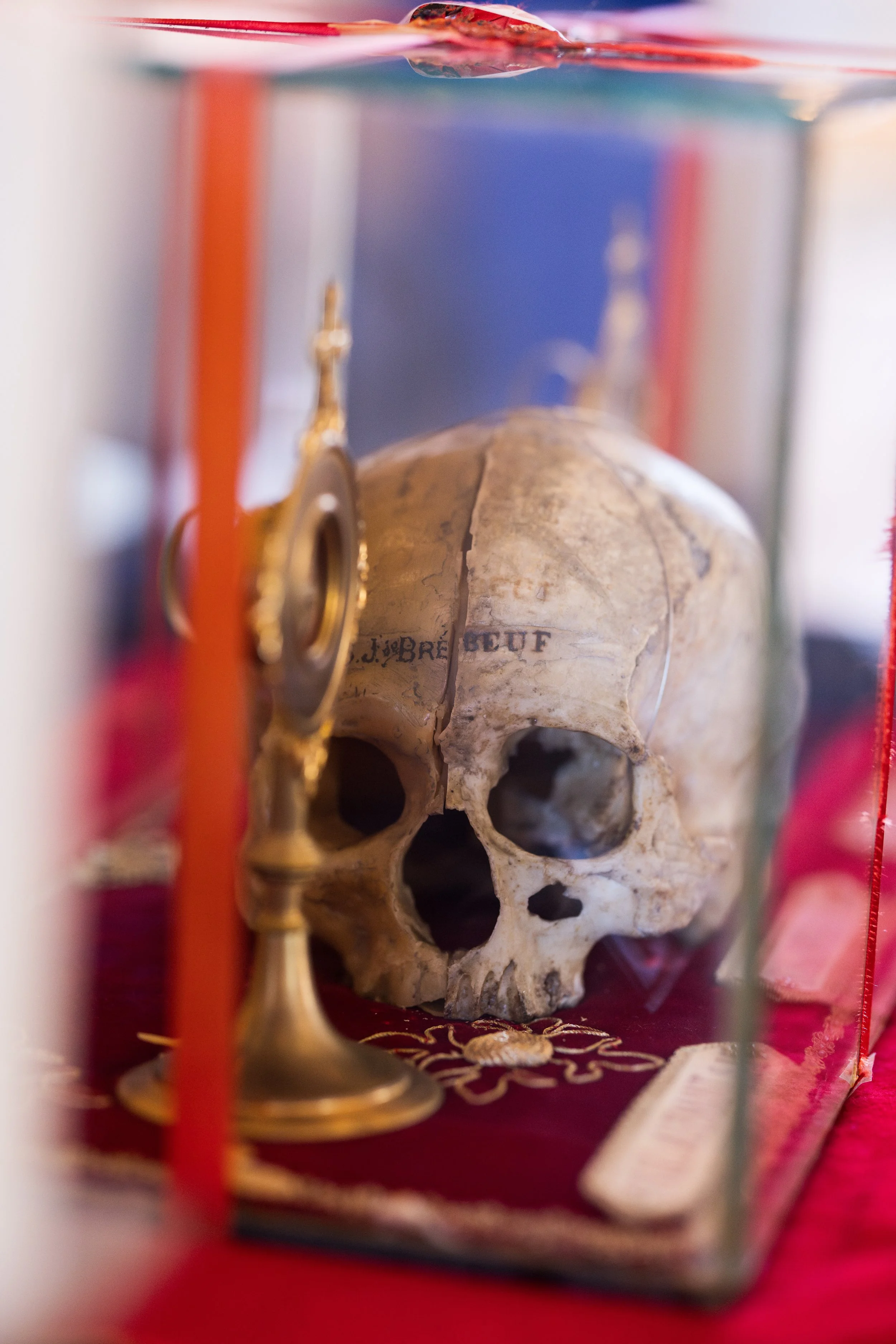
The skull of St. Jean de Brebeuf. Photo: Jesuits USA Central and Southern Province
Canonization and Commemoration
In recognition of his sacrifice and dedication, Jean de Brébeuf was canonized as a saint in 1930 by Pope Pius XI, alongside seven other North American martyrs. Their collective feast day is celebrated on September 26th, a time for the faithful to honour their legacy and the enduring impact of their missionary work. The Shrine of the Canadian Martyrs is a site consecrated to the memory of these fallen heroes of the Faith.
Honouring a Legacy
Below are a number of resources to learn more about the Canadian/North American Martyrs. We encourage you to take your time to read through them prayerfully and contemplatively.
-
From the Jesuit Relations
Note: I’m not sure why there are so many spelling mistakes!
CHAPTER III.
OF THE CAPTURE OF THE VILLAGES OF THE MISSION OF ST. IGNACE, IN THE MONTH OF MARCH OF THE YEAR 1649.
HE progress of the Faith kept increasing from day to day, and the blessings of Heaven were flowing down in abundance upon these peoples, when God chose to derive from them his glory in ways which are adorable, and which belong to the jurisdiction of his divine providence,—although they have been very severe for us, and were not in our expectations.
The 16th day of March in the present year, 1649, marked the beginning of our misfortunes,—if, however, that be a misfortune which no doubt has been the salvation of many of God's elect.
[34] The Iroquois, enemies of the Hurons, to the number of about a thousand men, well furnished with weapons,—and mostly with firearms, which they obtain from the Dutch, their allies,—arrived by night at the frontier of this country, without our having had any knowledge of their approach; although they had started from their country in the Autumn, hunting in the forests throughout the Winter, and had made over the snow nearly two hundred leagues of a very difficult road, in order to come and surprise us. They reconnoitered by night the condition of the first place upon which they had designs,—which was Surrounded with a stockade of pine trees, [page 123] from fifteen to sixteen feet in height, and with a deep ditch, wherewith nature had strongly fortified this place on three sides,—there remaining only a little a space which was weaker than the others.
It was at that point that the enemy made a breach at daybreak, but so secretly and promptly that he was master of the place before people had put themselves on the defensive,—all being then in a deep sleep, and not having leisure to reconnoiter their situation. Thus this village was taken, almost without striking a blow, there having been only ten Iroquois [35] killed. Part of the Hurons—men, women, and children—were massacred then and there; the others were made captives, and reserved for cruelties more terrible than death.
Three men alone escaped, almost naked, across the snows; they bore the alarm and terror to another and neighboring village, about a league distant. This first village was the one which we called Saint Ignace, which had been abandoned by most of its people at the beginning of the Winter,—the most apprehensive and most clear-sighted having withdrawn from it, foreboding the danger; thus the loss of it was not so considerable, and amounted only to about four hundred souls.
The enemy does not stop there; he follows up his victory, and before Sunrise he appears in arms to attack the village of Saint Louys, which was fortified with a fairly good stockade. Most of the women, and the children, had just gone from it, upon hearing the news which had arrived regarding the approach of the Iroquois. The people of most courage, about eighty persons, being resolved to [36] defend themselves well, repulse with courage the [page 125] first and the second assault, having killed among the enemy some thirty of their most venturesome men, besides many wounded. But, finally, number has the advantage,—the Iroquois having undermined with blows of their hatchets the palisade of stakes, and having made a passage for themselves through considerable breaches.
Toward nine o'clock in the morning, we perceived from our house at Sainte Marie the fire which was consuming the cabins of that village, where the enemy, having entered victoriously, had reduced everything to desolation,—casting into the midst of the flames the old men, the sick, the children who had not been able to escape, and all those who, being too severely wounded, could not have followed them into captivity. At the sight of those flames, and by the color of the smoke which issued from them, we understood sufficiently what was happening,—this village of Saint Louys not being farther distant from us than one league. Two Christians, who escaped from the fire, arrived almost at the same time, and gave us assurance of it.
In this village of Saint Louys were at that time two of our Fathers,—Father Jean de Brebeuf and Father Gabriel Lallement, [37] who had charge of five closely neighboring villages; these formed but one of the eleven Missions of which we have spoken above; we named it the Mission of St. Ignace.
Some Christians had begged the Fathers to preserve their lives for the glory of God,—which would have been as easy for them as for the more than 500 persons who went away at the first alarm, and had abundant leisure to reach a place of security; but their zeal could not permit them, and the salvation [page 127] of their flock was dearer to them than love for their own lives. They employed all the moments of that time, as the most precious which they had ever had in the world; and, during the heat of the combat, their hearts were only fire for the salvation of souls. One was at the breach, baptizing the Catechumens; the other, giving absolution to the Neophytes,—both animating the Christians to die in the sentiments of piety, with which they consoled them in their miseries. Accordingly, never was their faith, or the love which they had for their good Fathers and Pastors, more lively.
An Infidel, seeing affairs in a desperate condition, spoke of taking to flight; a [38] Christian, named Estienne Annaotaha, the most esteemed in the country for his courage and his exploits over the enemy, would never allow it. " What! " he said, " could we ever abandon these two good Fathers, who for us have exposed their lives? The love which they have had for our salvation will be the cause of their death; there is no longer time for them to flee across the snows. Let us then die with them, and we shall go in company to Heaven."
This man had made a general confession a very few days previously,—having had a presentiment of the danger wherein he saw himself involved, and saying that he wished that death should find him disposed for Heaven. And indeed he, as well as many other Christians, had abandoned himself to fervor in a manner so extraordinary, that we shall never be sufficiently able to bless the guidance of God over so many predestinated souls, for whom his divine Providence continues directing with love all the moments, both of life and of death. [page 129]
All this band of Christians fell, mostly alive, into the hands of the enemy; and with them, our two Fathers, the Pastors of that Church. They were [39] not killed on the spot; God was reserving them for much nobler crowns, of which we will speak hereafter.
The Iroquois having dealt their blow, and wholly reduced to fire the village of Saint Louys, retraced their steps into that of Saint Ignace, where they had left a good garrison, that it might be for them a sure retreat in case of misfortune, and that the victuals which they had found there might serve them as refreshments and provisions for their return.
On the evening of the same day, they sent scouts to reconnoiter the condition of our house at Sainte Marie; their report having been made in the Council of war, the decision was adopted to come and attack us the next morning,—promising themselves a victory which would be more glorious to them than all the successes of their arms in the past. We were in a good state of defense, and saw not one of our Frenchmen who was not resolved to sell his life very dear, and to die in a cause which—being for the interests of the Faith, and the maintenance of Christianity in these countries—was more the cause of God than ours; moreover, our greatest confidence as in him.
[40] Meanwhile, a part of the Hurons, who are called Atinniaoenten (that is to say, the nation of those who wear a Bear on their coat of arms), having armed in haste, were at hand the next morning, the seventeenth of March, about three hundred warriors,—who, while awaiting a more powerful help, [page 131] secreted themselves in the ways of approach, intending to surprise some portion of the enemy.
About two hundred Iroquois having detached themselves from their main body, in order to get the start and proceed to the attack of our house, encountered some advance-guards of that Huron troop. The latter straightway took flight after some skirmishing, and were eagerly pursued until within sight of our fort,—many having been killed while they were in disorder in the midst of the snows. But the more courageous of the Hurons, having stood firm against those who joined combat with them, had some advantage on their side, and constrained the Iroquois to take refuge within the palisades of the village of Saint Louys,—which had not been burned, but only the cabins. These Iroquois were forced into that palisade, and about thirty of them were taken captives.
[41] The main body of the enemy, having heard of the defeat of their men, came to attack our people in the very midst of their victory. Our men were the choicest Christians of the village of la Conception, and some others of the village of la Magdelaine. Their courage was not depressed, although they were only about one hundred and fifty. They proceed to prayers, and sustain the assault of a place which, having been so recently captured and recaptured, was no longer adequate for defense. The shock was furious on both sides,—our people having made many sallies, notwithstanding their small number, and having often constrained the enemy to give way. But,—the combat having continued quite far into the night,—as not more than a score of Christians, mostly wounded, were left, the victory remained wholly in the hands of the Infidels. It had, however, [page 133] cost them very dear, as their Chief had been seriously wounded, and they had lost nearly a hundred men on the spot, of their best and most courageous.
All night our French were in arms, waiting to see at our gates this victorious enemy. We redoubled our devotions, in which were our strongest [42] hopes, since our help could only come from Heaven. Seeing ourselves on the eve of the feast of the glorious Saint Joseph, the Patron of this country, we felt ourselves constrained to have recourse to a Protector so powerful. We made a vow to say, every month, each a Mass in his honor, during the space of a whole year, for those who should be Priests. And all, as many as there were people here, joined to this, by vow, sundry Penances, to the end of preparing us more holily for the accomplishment of the will of God concerning us, whether for life or for death; for we all regarded ourselves as so many victims consecrated to Our Lord, who must await from his hand the hour when they should be sacrificed for his glory, without undertaking to delay or to wish to hasten the moments thereof.
The whole day passed in a profound silence on both sides,—the country being in terror and in the expectation of some new misfortune.
On the nineteenth, the day of the great Saint Joseph, a sudden panic fell upon the hostile camp,—some withdrawing in disorder, and others thinking only of [43] flight. Their Captains were constrained to yield to the terror which had seized them; they precipitated their retreat, driving forth in haste a part of their captives, who were burdened above their strength, like packhorses, with the spoils which the victorious were carrying off,—their captors [page 135] reserving for some other occasion the matter of their death.
As for the other captives who were left to them, destined to die on the spot, they attached them to stakes fastened in the earth, which they had arranged in various cabins. To these, on leaving the village, they set fire on all sides,—taking pleasure, at their departure, in feasting upon the frightful cries which these poor victims uttered in the midst of those flames, where children were broiling beside their mothers; where a husband saw his wife roasting near him; where cruelty itself would have had compassion at a spectacle which had nothing human about it, except the innocence of those who were in torture, most of whom were Christians.
An old woman, escaped from the midst of that fire, bore the news of it to the village of Saint Michel, where there were about [44] seven hundred men in arms, who charged upon the enemy; but, not having been able to overtake him after two days' march, partly the want of provisions, partly the dread of combatting without advantage an enemy encouraged by his victories, and one who had mostly firearms, of which our Hurons have very few,—all these things obliged them to retrace their steps, without having done aught. They found upon the roads, from time to time, various captives, who—not having strength enough to follow the conqueror, who was precipitating his retreat—had had their heads split by a blow of the hatchet; others remained, half burned, at a post. [page 137]
CHAPTER IV.
OF THE BLESSED DEATHS OF FATHER JEAN DE BREBEUF, AND FATHER GABRIEL LALLEMENT.
S early as the next morning, when we had assurance of the departure of the enemy,—having had, before that, certain news, through some escaped captives, of the deaths of Father Jean de Brebeuf and of Father Gabriel Lallement,—we sent [45] one of our Fathers and seven other Frenchmen to seek their bodies at the place of their torture. They found there a spectacle of horror,—the remains of cruelty itself: or rather the relics of the love of God, which alone triumphs in the death of Martyrs.
I would gladly call them, if I were allowed, by that glorious name, not only because voluntarily, for the love of
God and for the salvation of their neighbor, they exposed themselves to death, and to a cruel death, if ever there was one in the world,—for they could easily and without sin have put their lives in safety, if they had not been filled with love for God rather than for themselves. But much rather would I thus call them, because, in addition to the charitable dispositions which they have manifested on their side, hatred for the Faith and contempt for the name of God have been among the most powerful incentives which have influenced the mind of the Barbarians to practice upon them as many cruelties as ever the rage of tyrants obliged the Martyrs to [page 139] endure, who, at the climax of their tortures, have triumphed over both life and death.
As soon as they were taken captive, they were stripped naked, and [46] some of their nails were torn out; and the welcome which they received upon entering the village of St. Ignace was a hailstorm of blows with sticks upon their shoulders, their loins, their legs, their breasts, their bellies, and their faces,—there being no part of their bodies which did not then endure its torment.
Father Jean de Brebeuf, overwhelmed under the burden of these blows, did not on that account lose care for his flock; seeing himself surrounded with Christians whom he had instructed, and who were in captivity with him, he said to them: " My children, let us lift our eyes to Heaven at the height of our afflictions; let us remember that God is the witness of our sufferings, and will soon be our exceeding great reward. Let us die in this faith; and let us hope from his goodness the fulfillment of his promises. I have more pity for you than for myself; but sustain with courage the few remaining torments. They will end with our lives; the glory which follows them will never have an end." " Echon," they said to him (this is the name which the Hurons gave the Father), " our spirits will be in Heaven when our bodies shall be suffering on earth. Pray to God for us, that he may show us mercy; we will invoke him [47] even until death."
Some Huron Infidels—former captives of the Iroquois, naturalized among them, and former enemies of the Faith—were irritated by these words, and because our Fathers in their captivity had not their tongues captive. They cut off the hands of one, and [page 141] pierce the other with sharp awls and iron points; they apply under their armpits and upon their loins hatchets heated red in the fire, and put a necklace of these about their necks in such a way that all the motions of their bodies gave them a new torture. For, if they attempted to lean forward, the red-hot hatchets which hung behind them burned the shoulders everywhere; and if they thought to avoid that pain, bending back a little, their stomachs and breasts experienced a similar torment; if they stood upright, without leaning to one side or the other, these glowing hatchets, touching them alike on all sides, were a double torture to them. They put about them belts of bark, filled with pitch and resin, to which they set fire, which scorched the whole of their bodies.
At the height of these torments, [48] Father Gabriel Lallement lifted his eyes to Heaven, clasping his hands from time to time, and uttering sighs to God, whom he invoked to his aid. Father Jean de Brebeuf suffered like a rock, insensible to the fires and the flames, without uttering any cry, and keeping a profound silence, which astonished his executioners themselves: no doubt, his heart was then reposing in his God. Then, returning to himself, he preached to those Infidels, and still more to many good Christian captives, who had compassion on him.
Those butchers, indignant at his zeal, in order to hinder him from further speaking of God, girdled his mouth, cut off his nose, and tore off his lips; but his blood spoke much more loudly than his lips had done; and, his heart not being yet torn out, his tongue did not fail to render him service until the last sigh, for blessing God for these torments, and [page 143] for animating the Christians more vigorously than he had ever done.
In derision of holy Baptism,—which these good Fathers had so charitably administered even at the breach, and in the hottest of the fight,—those wretches, enemies [49] of the Faith, bethought themselves to baptize them with boiling water. Their bodies were entirely bathed with it, two or three times, and more, with biting gibes, which accompanied these torments. " we baptize thee," said these wretches, " to the end that thou mayst be blessed in Heaven; for without proper Baptism one cannot be saved." Others added, mocking, " we treat thee as a friend, since we shall be the cause of thy greatest happiness up in Heaven; thank us for so many good offices,—for, the more thou sufferest, the more thy God will reward thee. "
These were Infidel Hurons, former captives of the Iroquois, and, of old, enemies of the Faith,—who, having previously had sufficient instruction for their salvation, impiously abused it,—in reality, for the glory of the Fathers; but it is much to be feared that it was also for their own misfortune.
The more these torments were augmented, the more the Fathers entreated God that their sins should not be the cause of the reprobation of these poor blind ones, whom they pardoned with all their heart. It is surely now that they say in repose, Transivimus [50] per ignem et aquam, et eduxisti nos in refrigerium.
When they were fastened to the post where they suffered these torments, and where they were to die, they knelt down, they embraced it with joy, and kissed it piously as the object of their desires and their love, and as a sure and final pledge of their [page 145] salvation. They were there some time in prayers, and longer than those butchers were willing to permit them. They put out Father Gabriel Lallement's eyes and applied burning coals in the hollows of the same.
Their tortures were not of the same duration. Father Jean de Brebeuf was at the height of his torments at about three o'clock on the same day of the capture, the 16th day of March, and rendered up his soul about four o ' clock in the evening. Father Gabriel Lallement endured longer, from six o'clock in the evening until about nine o'clock the next morning, the seventeenth of March.
Before their death, both their hearts were torn out, by means of an opening above the breast; and those Barbarians inhumanly feasted thereon, drinking their blood quite warm, which they drew from [51] its source with sacrilegious hands. While still quite full of life, pieces of flesh were removed from their thighs, from the calves of the legs, and from their arms,—which those executioners placed on coals to roast, and ate in their sight.
They had slashed their bodies in various parts; and, in order to increase the feeling of pain, they had thrust into these wounds red-hot hatchets.
Father Jean de Brebeuf had had the skin which covered his skull torn away; they had cut off his feet and torn the flesh from his thighs, even to the bone, and had split, with the blow of a hatchet, one of his jaws in two.
Father Gabriel Lallement had received a hatchet- blow on the left ear, which they had driven into his brain, which appeared exposed; we saw no part of his body, from the feet even to the head, which had [page 147] not been broiled, and in which he had not been burned alive,—even the eyes, into which those impious ones had thrust burning coals.
They had broiled their tongues, repeatedly putting into their mouths flaming brands, and burning pieces of bark,—[52] not willing that they should invoke, in dying, him for whom they were suffering, and who could never die in their hearts. I have learned all this from persons worthy of credence, who have seen it, and reported it to me personally, and who were then captives with them,—but whoa having been reserved to be put to death at another time, found means to escape.
But let us leave these objects of horror, and these monsters of cruelty; since one day all those parts will be endowed with an immortal glory, the greatness of their torments will be the measure of their happiness, and, from now on, they live in the repose of the Saints, and will dwell in it forever.
We buried these precious relics on Sunday, the 21st day of March, with so much consolation and such tender feelings of devotion in all those who were present at their obsequies, that I know none who did not desire a similar death, rather than fear it; and who did not regard himself as blest to stand in a place where, it might be, two days thence, God would accord him the grace of shedding both his blood [53] and his life on a like occasion. Not one of us could ever prevail upon himself to pray to God for them, as if they had had any need of it; but our spirits were at once directed toward Heaven, where we doubted not that their souls were. Be this as it may I entreat God that he fulfill upon [page 149] us his will, even to death, as he has done in their persons.
Father Gabriel Lallement was the last to come to the combat, and yet has fortunately borne away one of the first crowns. I mean to say that, although it is but six months since he arrived in this Mission of the Hurons,—and that, last of all,—he has been chosen by God as one of the first victims sacrificed to the hatred for the Christian name and Faith.
For several years, he had been asking God, with tears and sighs, to be sent to this Mission in the end of the world, notwithstanding his very delicate constitution. and the fact that his body had no strength except what the spirit of God, and the desire of suffering for his name, could give him. I cannot grudge to the public a private writing from his hand, which I found after his death, concerning the motives which he [54] had had, for so ardently desiring occupation in these Missions. Here are his own words:
" It is, my God, my Savior; 1st, to make good the obligations which I feel toward you: for if you abandoned your contentments, your honors, your comforts your joys, and your life, in order to save me, wretched one,—is it more than reasonable that I abandon, after your example, all these things for the salvation of souls,—which you esteem yours, which have cost you your blood; which you have loved even until death, and of which you have said, Quod uni em minimis meis fecistis, mihi fecistis?
"2. Even though, indeed, I were not moved by a spirit of gratitude, in making you these burnt-offerings of myself, I would do so with all my heart in consideration of the grandeurs of your adorable Majesty, and of your infinitely infinite goodness,—[page 151] which deserves that a man sacrifice himself to your service, and that he blessedly cast himself away, in order to accomplish faithfully what he judges to be your will concerning him, and special inspirations which it pleases you to give him for the good of your [55] greater glory.
"3. Since I have been so wicked as to offend so greatly your goodness, O my Jesus, it is right to make amends to you by extraordinary pains: and thus I must walk before your face the remainder of my life, with my heart humbled and contrite in the endurance of the evils which you first suffered for me.
"4. I am indebted to my parents, to my mother, and to my brothers, and I must draw upon them the effects of your mercies. My God, never permit that any of this family, for which you have had so much love, shall perish in your presence, or that he be of the number of those who are destined to blaspheme you eternally. Let me be for them the victim,—Quoniam ego in flagella paratus sum; hîc ure, hîc seca, ut in œternum parcas.
"5. Yes, my Jesus and my love, it must therefore be that your blood, shed for the Barbarians as well as for us, be efficaciously applied for their salvation; and this is wherein I wish to coöperate with your grace, and to sacrifice myself for them
"6. It must be that your name be adored, that your Kingdom be extended through all the [56] Nations of the world; and that I consume my life, in order to withdraw from the hands of Satan, your enemy, these poor souls who have cost you both your blood and your life.
"7. Finally, if it be reasonable that some one [page 153] incline, from love, to give this satisfaction to Jesus Christ,—though at the risk of a hundred thousand lives, if he had so many, and with the loss of everything which is sweetest and most agreeable to nature,—thou wilt never find any one who is more obliged to undertake it than thou. Up then, my soul, let us blessedly cast ourselves away, in order to give this satisfaction to the sacred heart of Jesus Christ; he deserves it, and thou canst not forego it, if thou wouldst not live and die ungrateful to his love."
Such are the motives which had animated his zeal to come and die with us in the midst of this barbarism. There was no one more innocent than he, for he had left the world since his tender youth; and, in the nineteen years since he had been a Religious of our Society, he had always walked with a conscience so pure that the least shadow,—I will not say of sin, but of thoughts which approach it, and are not at all criminal—served only [57] to aid him in uniting himself more to God.
After his arrival here among the Hurons, he had applied himself with so much ardor to learn the language,—thankless, if ever there were such a one in the world,—and subsequently had made in it so much progress, that we did not doubt that God wished to use him in these countries for the advancement of his glory. His charity found no difference between the study of the higher sciences, which had occupied him until then, and the thorny difficulties of a barbarous language, which has nothing attractive about it,—except in so far as zeal for the salvation of one's neighbor leads one to find beauties in it. It is not one of the least difficulties in these countries, [page 155] that it is necessary to become a child at the age of 39 years, in order to learn to speak.
After all, his course has been quickly finished; but in this little time he has fulfilled the expectations which earth and Heaven could have for his labors. He has died in the cause of God, and has found in these countries the Cross of Jesus Christ which he sought in them,—of which he has borne upon himself the truly bloody marks.
Although, in leaving the world, he had left the share which his birth gave him in [58] honorable offices, yet I can say, with truth, that the robe which he has crimsoned with his blood is a thousand times more precious than the purple, or the loftiest expectations which the world could have promised him.
He was born at Paris, on the 31st of October in the year 1610. He entered our Society on the 24th of March in the year 1630; he died in it, upon a bed of glory, on the 17th of March in the current year, 1649, The Hurons named him Atironta. [page 157]
CHAPTER V.
SOME REMARKS ON THE LIFE OF FATHER JEAN DE BREBEUF .
ATHER Jean de Brebeuf had been chosen by God to be the first Apostle of the Hurons, the first of our Society who set foot there,—and who, not having found there a single Savage who invoked the name of God, labored there so successfully for the salvation of those poor Barbarians that before his death he had the consolation of seeing nearly seven thousand baptized there, and the Cross of Jesus Christ planted [59] everywhere with glory, and adored in a country which, from the birth of the world, had never been Christian.
He was sent to New France in the year 1625, by the Reverend Father Pierre Coton; and for his first attempt, his first apprenticeship, he spent the winter roving in the woods, with the Montagnais tribes nearest Kebec, in which life he had much to suffer, until the Summer of the following year, 1626, He then came up here to the Hurons, devouring the difficulties of these barbarous languages with a success so felicitous that he seemed to have been born only for these countries. He adapted his own nature and temperament to the customs among these peoples, with so much ability,—becoming all things to all men, in order to win them to Jesus Christ,—that he had ravished their hearts, and was singularly loved there, when he was constrained to return to France, [page 159] in the year 1629,—the English having made themselves masters of this country, and not being willing to suffer in it the Preachers of the Faith.
The Englishman having been constrained to let go his hold, and to withdraw from a country which he occupied unjustly, the same Father was sent back to it in the year 1633, when he found himself [60] obliged to winter again at Kebec, being unable to go up to the Hurons before the following year,—though he was already master of the language, and was filled with the hopes that he had for the conversion of these tribes.
For so high an enterprise was required an accomplished man, and especially one of eminent holiness. This is what he did not see in himself, but what all those who have known him have always admired in him,—a virtue in which nothing was wanting, and which seemed to be natural to him, although that which appeared without was nothing in comparison with the treasures of grace wherewith God continued to enrich him, from day to day, and with the favors which he showed him.
Often, Our Lord appeared to him,—sometimes in a state of glory, but usually bearing his Cross, or indeed, being attached to it; these visions implanted in his heart such ardent desires to suffer much for his name, that, although he had greatly suffered on a thousand occasions,—difficulties, fatigues, persecutions, griefs,—all was naught to him, and he complained of his misfortune,—believing that he had never suffered anything, and that God did not find him worthy of having him bear the [61] least share in his Cross.
Our Lady also appeared to him very often; she usually left in his soul desires for suffering, but with [page 161] feelings so serene, and such submission to the will of God, that afterward his spirit remained for the space of several days in deep peace and in a lofty realization of the greatness of God.
In the year 1640, when he spent the whole Winter on a Mission to the Neutral Nation, a great cross appeared to him, which came from the direction of the Iroquois Nations. He mentioned it to the Father who accompanied him; the latter asking him for some further details of this apparition he answered him only this, that this cross was so great that it was adequate to hold not only one person, but all of us who were in these countries.
He had been commanded to write these extraordinary things which occurred within his soul,—at least, those which he could most easily remember; for they were too frequent, and care for the salvation of his neighbor hardly gave him any leisure to write from time to time. Here are the last two items which I have found [62] in his memoirs.
"Many crosses appeared to me, all of which I very gladly embraced. On the following night, while in prayer,—conforming myself to the will of God concerning me, and saying to him, Fiat voluntas tua, Domine; quid me vis facere?—I heard a voice which said to me, Tolle, Lege. The day having come on, I took in hand the little book of the 'Imitation of Jesus Christ;' and, without design, I fell upon the chapter, De rigiâ viâ sanctæ crucis. From that time I felt in my soul a great peace, and repose in occasions of suffering.
" Toward evening, being in prayer before the most blessed Sacrament, I saw in spirit, upon my clothes and upon the clothes of all our Fathers, [page 163] without any exception, spots all of blood,—which left me in a sentiment of admiration."
We know nothing further of this; and yet perhaps God has not chosen to warn us, by those crosses and that blood, that he will accord us the same favor with which he has chosen to recompense the merits of this good Father,—to die for his name, and to shed our blood for the establishment of his glory. Be this as it may, we [63] pray him that his most holy will be fulfilled regarding us, even to death.
This good Father felt himself so inclined to procure the glory of God, and to have only that in sight, that, more than eleven years before his death, he bound himself by a vow to do and suffer all that, during the remainder of his life, he might recognize as requisite to the greater glory of God,—a vow which he renewed every day at the altar, at the time of the most holy Communion.
From that time, I see nothing more frequent in his memoirs than the desires which he had to die for the glory of Jesus Christ: Sentio me vehementer impelli ad moriendum pro Christo,—desires which continued with him eight or ten days in succession. Finally, wishing to become a burnt-offering, and a victim consecrated to death, and in order to anticipate more holily the happiness of the martyrdom which was awaiting him, he devoted himself to it in a vow which he conceived in these terms:
Quid retribuam tibi, Domine mi Jesu, pro omnibus quæ retibuisti mihi? Calicem tuum accipiam, et nomen tuum invocabo. Voveo ergo in conspectu æterni Patris tui, sanctíque Spiritus, in conspects sacratissimæ Matris tuæ castissimíque ejus sponsi Josephi; coram Angelis, [64] Apostolis et Martyribus, sanctisque meis parentibus[page 165]Ignatio, et Francisco Xaverio, Voveo, inquam, tibi, Domine mi Jesu, si mihi unquam igdigno famulo tuo, Martyrii gratia misericorditer à te oblata fuerit, me huic gratiæ non defuturum: sic ut in posterum licere mihi nunquam velim, aut quæ sese offerent moriendi pro te occasiones declinare, (nisi ita fieri ad majorem gloriam tuam judicarem) aut jam inflictum mortis ictum, non acceptare gaudenter. Tibi ergo, Domine mi Jesu, et sanguinem et corpus, et spiritum meum jam ab hac die gaudenter offrero, ut pro te, si ita dones, moriar; qui pro me mori dignatus es. Fac ut sic vivam, ut ita mori tandem me veles. Ita, Domine, calicem tuum accipiam, et nomen tuum invocabo, Jesu, Jesu, Jesu.
"My God and my Savior Jesus, what can I render to you for all the benefits which you have conferred upon me? I will take from your hand the cup of your sufferings, and I will invoke your Name. I then make a vow,—in the presence of your Eternal Father and of the Holy Ghost; in the presence of your most sacred Mother, and of her most chaste spouse, Saint Joseph; before the Angels, the Apostles and Martyrs, and my blessed Fathers Saint Ignatius and St. [65] Francis Xavier,—yes, my Savior Jesus, I make a vow to you never to fail, on my side, in the grace of martyrdom, if by your infinite mercy you offer it to me some day, to me, your unworthy servant. I bind myself to it in such a way that I intend that, during all the rest of my life, it shall no longer be a lawful thing for me, when remaining at my option, to avoid opportunities of dying and of shedding my blood for you. (Save only that, in some emergency, I should judge that, for the time being, it might be to the interests of your glory to behave otherwise in the matter.) And when I shall have [page 167] received the stroke of death, I bind myself to accept it from your hand with all pleasure, and with joy in my heart. And consequently, my beloved Jesus, I offer to you from today, in the feelings of joy that I have thereat, my blood, my body, and my life; so that I may die only for you, if you grant me this favor, since you have indeed condescended to die for me. Enable me to live in such a way that finally you may grant me this favor, to die so happily. Thus, my God and my Savior, I will take from your hand the cup of your sufferings, and I will invoke your [66] Name, Jesus, Jesus, Jesus."
Often the Infidels conspired for his death. If any misfortune had befallen the country, it was the Jesuits who were the cause of it, and Echon the chief of all. If pestilence prevailed, and contagious diseases depopulated certain villages, it was he who by his spells caused those Demons of hell to come, with whom he was accused of having dealings. Famine appeared here only by his orders; and, if the war were not favorable to them, it was Echon who had a secret understanding with their enemies; who surreptitiously received pensions from them, for betraying the country; and who had come from France only to exterminate all the tribes with whom he should deal, under the pretext of coming to announce the Faith there, and of procuring their welfare. In a word, the name of Echon has been, for the space of some years, held in such abhorrence that it was used for terrifying the children; and often sick people have been made to believe that his look was the Demon who had bewitched them and who gave the death-blow. But his hour was not come; all those evil designs which they had against him [page 169] served only to [67] augment his confidence in God, and to cause that every day he walked like a victim devoted to death, which he awaited only with loving desire, but of which he dared not speed the moments.
Our Lord often gave him to understand that he held us in his protection, and that the powers of hell might indeed become furious against us, but that they were not unchained. In the year 1637, when the cry arose throughout the country, " Murder them ! " " Massacre them ! "—as if we had been the authors of the contagious diseases which ravaged everywhere,—and when they had decided to exterminate us, a troop of Demons appeared to him at sundry times. These were now like men who were becoming enraged, at other times like awful monsters,—bears, lions, untamed horses,—which strove to fall upon him. These spectres gave him no horror, nor any impulse of fear; he placed his confidence in God. He said to them, " Do upon me that which God permits you; for without his will a hair will not fall from my head." And at these words, all those Demons disappeared in a moment.
[68] At other times, he saw death attached, with hands behind, to a post near him, endeavoring to spring forward in fury; but, unable to burst the bonds with which he saw it restrained, it fell at his feet without strength and without vigor, powerless to hurt him.
In the year 1640, being in the Neutral Nation, he said one evening to the Father who was with him that death, like a fleshless skeleton, had appeared to him threatening him. Not knowing what that signified, he was much astonished when, the next morning, one of our good friends, Captain of the village [page 171] where they were, came to bring the news to our Fathers that an Infidel Huron, named Aoenhokoui,—recently arrived in the Neutral Nation, and a deputy from the elders of the country,—having convoked the Council, had made a present there of nine hatchets (these are great riches in this country), in order that they should strike our Fathers dead, and that the consequences of this murder might not fall upon the Hurons. This affair had occupied the Council all night; but finally the Captains of the Neutral Nation would not listen to it.
[69] He derived this spirit of confidence in God from prayer, in which he was often much uplifted. A single word would give him a theme for whole hours,—not to his intellect, of whose inaction he was wont to complain, but to his heart, which relished the eternal truths of the Faith, and which remained attached to them with serenity, with love, and with joy. And, notwithstanding this facility of converse with God, he prepared himself for prayer as punctiliously as a Novice would do in his early stages.
By day,—his neighbor's needs not allowing him to occupy himself in solitude with God, according to the extent of his heart's desires,—he anticipated the usual hour, rising very early. Nevertheless, for the same reason, he urged every day far into the night, until nature was powerless to go further; and, sleep constraining him to succumb, he lay upon the ground,—fully dressed as he was, and a piece of wood serving him as pillow,—giving to the body only what he could not, in conscience, have denied it. At one time I find in his writings that, while he was in prayer, God detached him from all his senses, [70] and united him to himself; again, that he was [page 173] enraptured in God, and fervently embraced him; at other times, he says that his whole heart was transported to God by bursts of love which were ecstatic. But above all, this love was tender with respect to the sacred person of Jesus Christ, and of Jesus Christ suffering.
Often he felt this love as a fire, which, having inflamed itself in his heart kept increasing from day to day, and consuming in him the impurity of natures in order to cause the spirit of grace and the adorable spirit of Jesus Christ to rule in him.
At the feasts of Pentecost in the year 1640,—being at night in prayer, in the presence of the most blessed Sacrament, he saw himself in a moment invested with a great fire, which burned, without consuming aught, everything which was there around him: and, while these flames lasted he felt himself inwardly on fire with the love of God, more ardently than he had ever been.
He had many notable apparitions of Our Lady, of Saint Joseph, of the Angels, and of the Saints. He saw one day a high mountain all covered with Blessed [71] Virgins who were in glory—in such sort that, from the foot of the mountain even to the summit, the ranks continued to decreases until they were reduced to a unit, which was Our Lady, seated on the summit of that hill.
Sometimes, merely at the sight of the clothes with which the most blessed Virgin appeared to him to be clad, and of the fringes which hung at the bottom of her robes he was so much occupied and absorbed in the luster of her glory that he dared not raise his eyes higher for fear of being oppressed with the excess of the lights which might flash from her face. [page 175]
But those were not the favors which he desired, nor which he had ever desired. And he kept those favors so secret and concealed, except to those from whom he could not in conscience conceal anything, that he never spoke of them? nor even gave any one at all the least indication of them. And the conclusion which he drew from them, every time, was to humiliate himself further, to distrust himself, to esteem himself the least of the household, and to feat lest the Devil should deceive him. Finally, he never guided himself by these visions, although often God had [72] given him to understand things, afar off, and even gave him great illuminations ill the secret place of conscience, and in the depth of the heart. But he guided himself solelyby the principles of the Faith, through the operations of obedience and the lights of reason.
One day, speaking in prayer to Our Lord, and saying to him, Domine, quid me vis facere.?—he heard this answer, which Jesus Christ formerly made to St. Paul: Vade ad Ananiam, et ipse dicet tibi quid te oporteat facere. And from that time he was so confirmed in the resolutions which he had, of never seeking other guidance than that of obedience, that I may say, in truth, that this virtue was perfect in him,—seeing only God in the person of the Superior, discovering his heart to him with a child's simplicity, showing an entire docility to the answers which were given him, and acquiescing without resistance in everything which was said to him, although contrary to his natural inclinations,—not only in that which appeared to the eyes of men, but in the depth of his heart, where he knew that God sought the true obedience . [page 177]
[73] He said that he was fit only to obey, and that this virtue was natural to him, because—not having great intelligence and great prudence, and being incapable of guiding himself—he had as much pleasure in obeying as a child, who, not having enough strength to walk, takes pleasure in allowing himself to be carried in his mother's bosom, to whatever place it is necessary to go. Agnovi in me nullum esse talentum (he says in a paper which he wrote in the year 1631), tantùm pronum esse me ad obediendum; mihi visus sum aptus ad januam custodiendam, ad triclinium parandum, ad culinam faciendam. Geram me in Societate, ac si essem mendicus, per gratiam admissus in Societatem, et omnia mihi cogitabo fieri ex mera gratiâ. And yet he had a very excellent judgment, and a prudence as holy; and he was so detached from the passions which usually deceive us that I admired him every day in the conduct of the affairs wherein he was consulted, or of which he was given the management .
He had asked, on entering the Society, to be a Brother Coadjutor; and, before taking his vows, he proposed this again, esteeming himself unworthy of the Priesthood, and best fitted [74] for the humblest of fines,—which, in fact, he discharged extremely well whenever he was directed to them, either through necessity, or sometimes in obedience to his own humility. But he was not less capable of great things; and when he was Superior of this Mission, and when I had the benefit of being under him, I admired his management; his gentleness, which won hearts; his courage, truly generous in enterprises; his long-suffering in awaiting the moments of God; his patience in suffering everything; and his zeal in [page 181] undertaking everything which he saw for the glory of God.
It is very true that his humility caused him to- embrace with more love, more joy,—and, I may say, with more natural inclination,—the humblest and the most painful duties. If we were on a journey, he bore the heaviest burdens; if it were necessary to go through channels, he rowed from morning till evening; it was he who first sped to the water, and left it the very last,—notwithstanding the rigors of the cold and ice, when his bare legs were all red therefrom, and his body all chilled. He was the first to rise, [75] to make the fire and to cook, and the last of all in bed, finishing by night his prayers and his devotions. And, however harassed he was; whatever fatigues he endured, over roads which cause horror, and in which the most vigorous bodies lose courage; after all the labors of the day,—and sometimes thirty days in succession without rest, without refreshments, without relaxation, often even not having the means to take a single meal with leisure,—he nevertheless found time to acquit himself of all which our rules would require from a man who should not be so urgently employed, omitting none of his usual devotions, whatever occupation might come unexpectedly upon him. Accordingly, he sometimes said that God gave us the day for dealing with our neighbor, and the night for conversing with him. And what was most remarkable in those fatigues which he took upon himself is, that he did this so quietly and so cleverly that one might have supposed, to see him, that his nature had found its motive therein. " I am an ox," he said, alluding to his name, " and am fit only to bear burdens." [page 181]
To the continual sufferings which are [76] inseparable from the duties which he had in the Missions, on the journeys, in whatever place he was; and to those which charity caused him to embrace,—often above his strength, although below his courage,—he added many voluntary mortifications: disciplines every day, and often twice each day; very frequent fasts; haircloths, and belts with iron points; vigils which advanced far into the night. And, after all these, his heart could not be satiated with sufferings, and he believed that he had never endured aught. A very few years before his death, writing of himself, he speaks of the matter in these terms: Timui meam reprobationem, eò quòd nimis suaviter hactenus mecum egerit Deus, tuuc benè de mea salute sperabo, cùm patiendi occasiones se dederint,—" I have been afraid lest I be of the number of the reprobate, seeing that God has treated me hitherto with so much mildness: then I shall hope that God will choose to show me mercy, when his goodness shall furnish me opportunities of suffering something for his love." And yet we may say that his life was but one continuation of crosses and of sufferings.
[77] When any humiliation befell him, he blessed God for it, and felt from it an inward joy,—saying to those from whom he could not conceal all the emotions of his heart that those were not humiliations for him, because in whatever low place he might be, he always saw himself higher than he wished; and that he had as much inclination for descending Continually lower as has a stone, which never has a tendency to rise. Accordingly, he begged the Superiors to humiliate him; and the good thing is that when, in order to cooperate with the grace of God [page 183] upon him, we did not spare him, we always found an even spirit, a contented heart, and a most serene countenance.
This sweetness of temper was the virtue in him which seemed to float above all the others; it was proof against everything. In the twelve years during which I have known him, when I have seen him as superior, as inferior, or as the equal of all,—now in temporal affairs, now in the labors and fatigues of the Missions; dealing with the Christian Savages, with Infidels, with Enemies; in sufferings, in persecutions, and in calumnies,—never have I seen him either in [78] anger, or even in the appearance of any indignation. Often, indeed, some persons have specially endeavored to annoy him, and to attack him unawares at what they believed must be his most sensitive points; but his look was always benign, his words were in mildness, and his heart in calmness. Accordingly, Our Lord had especially given him this grace.
In the year 1634, while accomplishing the Spiritual Exercises of the Society, our Lord appeared to him, crowned with thorns, and said to him these words: Habebis deiceps unctionem Spiritus in verbis tuis,—"Thou shalt have henceforth in thy words the anointing of the Holy Spirit. " And in the year 1640, in his act of thanks after holy Mass, he saw and felt a hand which anointed both his heart and the powers of his soul with a sacred balm. Ex qua visione, summa animi mei pax, et tranquillitas, consecuta est.—he adds in his memoirs.
A very few days after this vision, a sedition arose against us in the village of Saint Joseph, in which he was severely beaten, and with him some of our [page 185] Fathers,—the Captains themselves being the firebrands which kindled the sedition, [79] exciting against us the populace, who loaded us with insults and threatened to burn us. At evening, when the Father was thanking God for all that had happened,—feeling, nevertheless, some distress in his hearts proceeding from the fear lest those wretches should impede the progress of the Faith,—Our Lady appeared to him, having her heart pierced with three swords; and at the same time he was aware of an inward voice, which told him that the most blessed Virgin had always been perfectly submissive to the will of God, although often her heart had been deep in affliction: and that he must take her in his adversity for an example of what God wished from him.
The oil of this mildness did not extinguish the ardor of his zeal, but rather inflamed it, and was one of the most powerful means which God had given him for winning hearts to the Faith. He acknowledges this himself in these terms, in some remarks that he wrote in the year 1638, while making a review of the state of his soul. " God," he says, " through his goodness has given me a gentleness, benignity, and charity with respect to every one; [80] an indifference to whatsoever may happen; a patience for suffering adversities; and the same goodness has willed that, through these talents which he has given me, I shall advance to perfection, and shall lead others to eternal life. And consequently," he adds, " I will henceforth make my examination thorough, to see whether I indeed make a good use of those talents, for which I am responsible."
Here is a truly remarkable thing, which happened to him in the year 1640, during the time of his retreat [page 187] for the Spiritual Exercises. He writes it in these terms: " Contemplating the enormity of my sins, and their countless number, I saw Our Lord, who, with an infinite mercy, was holding out his loving arms to embrace me. He pardoned me the past, and forgot my sins; he restored in my soul both his gifts and his graces; he called me to his love, and said to me what formerly he said to Saint Paul: Vas electionis est iste, ut portet nomen meum in gentibus; ostendam ibi quanta oporteat eum pro nomine meo pati. Hearing these words, I thanked him for them, I offered myself for that, and said to him Quid me vis facere? fac me virum secundum cor tuum; nihil me in posterum separabit à charitate tua: non nuditas, [81] non gladius, non mors," etc.
It was in the ardor of this zeal that he offered himself very often to God, to suffer all the martyrdoms in the world, for the conversion of these peoples. " O my God, why are you not known? " he wrote some time before dying; " why is this Barbarous country not all converted to you? Why is not sin abolished from it? Why are you not loved? Yes, my God, if all the torments which the captives can endure in these countries in the cruelty of the tortures, were to fall on me, I offer myself thereto with all my heart, and I alone will suffer them."
In another place, he writes these words: " Two days in succession, I have felt in me a great desire for martyrdom, and for enduring all the torments which the Martyrs have suffered. "
What gave him this courage was, on one side, distrust of himself; and, on another side, confidence in God, in the complete conformity which he had to his divine will. one day, asking him whether, if he [page 189] were taken by the Iroquois, he would not feel a very great repugnance if they had him stripped naked, " No, " he answered me, [82] " for it would be the will of God; and then I should not think of myself, but of God." Being asked whether he had not a horror of the fire, " I would fear it," he said, " if I contemplated my weakness; for the sting of a fly would be able to vex my patience. But I hope that God will always assist me, and, aided by his grace, I no more fear the terrible torments of the fire than the pricking of a pin.''
I would never be at an end of perusing the virtues which were in him. I may say, with truth, that I have material for composing a whole biography of them,—which would be full of the glorious illuminations which he had in the ways of holiness; of the favors of God toward him, which were extraordinary; and of the continual fidelity with which he responded to those favors, as well in little things as in great ones, for he esteemed nothing little in the service of God His poverty was so destitute that he had not even a single medal, nor anything at all in this world of which he desired to have the use, unless for necessity alone. In the year I637, our Lord showed him a superb Palace, richly 083] built, in beauties inconceivable, and in so many and such surprising varieties, that he was quite ravished out of himself, and could not comprehend even his own feelings. As this Palace was empty,—there being no one in it,—it was given him to understand that it was prepared for those who should dwell in poor cabins, and who had condemned themselves to these for the love of God; this greatly consoled him.
His chastity was proof; and in that matter his eyes [page 191] were so faithful to his heart, that they had no sight for the objects which might have soiled purity. His body was not rebellious to the spirit; and in the midst of impurity itself,—which reigns, it seems, in this country,—he lived in an innocence as great as if he had sojourned in the midst of a desert inaccessible to that sin. A woman presented herself one day to him, in a place somewhat isolated, uttering to him unseemly language, and breathing a fire which could come only from a firebrand of hell. The Father, seeing himself thus attacked, made upon himself the sign of the cross, without answering any word; and this spectre, disguised beneath a woman's dress, disappeared at the same moment.
[84] The purity of his conscience was like the apple of the eye, which cannot suffer the least little dust, or a single grain of sand. From the year 1630, he writes that he felt in himself no attachment for any venial sin, nor the least pleasure in the world; that his will was as averse to it as to his greatest enemy; and that he would rather choose all the pains of hell than the least sin. And yet a little after, on the same day, he adds these words: Ne me Deus tanquam infructuosam arborem succideret, oravi ut me dimitteret adhuc hoc anno, et promisi me meliores fructus allaturum,—" For fear that God should cut me off at the root, as a fruitless tree, I have prayed him that he still suffer me to stand, this year; and I have promised him that I would yield him better fruits than in the past."
It once escaped him to tell one of our Fathers, that, since he had been among the Hurons, he had not sought even a single time his own taste in eating. As for me,—though I have been very [page 193] intimately associated with him, as much as any man in the world,—I have never been able to recognize in him any fault, not only what was sin, but not [85] even what infringed the least of our Rules. This also was one of his good sayings for nearly twenty years: Disrumpar potiùs quam ut voluntariè regulam ullam infringam. And this exactness was not only in that which appeared to the sight, but penetrated into the deepest recess of his heart. Nullum in corde commercium mihi habendum cum creaturis,—" The whole converse of my heart shall be with God; creatures shall no longer be aught to me." Numquam quiescam, numquam dicam satis,—" I will take no rest; never will I say that I shall have done enough.
" More than fifteen years before dying, in the memoirs that he wrote, making the review of his conscience from month to month,—here follows what he says of himself: " I feel in me a great desire to die, in order to enjoy God; I feel a great aversion for all things created, which it will be necessary to leave at death. It is in God alone that my heart rests; and, outside of him, all is naught to me, except for him.
" His death has crowned his life, and perseverance has been the seal of his holiness. He died at thf age of 56 years. He was born on the 25th of March in the year 1593, the day of the Annunciation of Our Lady,—of worthy parents, [86] in the Diocese o Bayeux; he entered our Society in the year 1617, on the fifth day of the month of October. He died while preaching, and exercising truly Apostolic offices,—and by a death which the first Apostle to the Hurons deserved. His martyrdom took place on the 16th day of March in the current year, 1649. [page 195]
-
Note: I’m not sure why there are so many spelling mistakes!
A veritable Account of the Martyrdom and Blessed death of Father Jean de
Brebœuf and of Father Gabriel L'Alemant, in New France, in the country of
the Hurons, by the Iroquois, enemies of the Faith.
FATHER Jean de Brebœuf and Father Gabriel L'Alemant had set out from our cabin, to go to a small Village, called St. Ignace, distant from our cabin about a short quarter of a League, to instruct the Savages and the new Christians of that Village. It was on the 16th Day of March, in the morning, that we perceived a great fire at the place to which these two good Fathers had gone. This fire made us very uneasy; we did not know whether it were enemies, or if the fire had caught in some of the huts of the village. The Reverend Father Paul Ragueneau, our Superior, immediately Resolved to send some one to learn what might be the cause. But no sooner had we formed the design of going there to see, than we perceived several savages on the road, coming straight toward us. We all thought it was the Iroquois who were coming to attack us; but, having considered them more closely, we perceived that they were Hurons who were fleeing from the fight, and who had escaped from the combat. these poor savages caused great pity in us. They were all covered with wounds. One had his head fractured; another his arm broken; another had an [page 25] arrow in his eye; another had his hand cut off by a blow from a hatchet. In fine, the day was passed in receiving into our cabins all these poor wounded people, and in looking with compassion toward the fire, and the place where were those two good Fathers. We saw the fire and the barbarians, but we could not see anything of the two Fathers.
This is what these Savages told us of the taking of the Village of St. Ignace, and about Fathers Jean de Brebceuf and Gabriel Lalemant:
"The Iroquois came, to the number of twelve hundred men; took our village, and seized Father Brebeuf and his companion; and set fire to all the huts. They proceeded to vent their rage on those two Fathers; for they took them both and stripped them entirely naked, and fastened each to a post. They tied both of their hands together. They tore the nails from their fingers. They beat them with a shower of blows from cudgels, on the shoulders, the loins, the belly, the legs, and the face,—there being no part of their body which did not endure this torment. " The savages told us further, that, although Father de Brebeuf was overwhelmed under the weight of these blows, he did not cease continually to speak of God, and to encourage all the new Christians who were captives like himself to suffer well, that they might die well, in order to go in company with him to Paradise. While the good Father was thus encouraging these good people, a wretched Huron renegade,—who had remained a captive with the Iroquois, and whom Father de Brebeuf had formerly instructed and baptized,—hearing him speak of Paradise and Holy Baptism, was irritated, and said [page 27] to him, " Echon," that is Father de Brebeuf's name in Huron, "thou sayest that Baptism and the sufferings of this life lead straight to Paradise; thou wilt go soon, for I am going to baptize thee, and to make thee suffer well, in order to go the sooner to thy Paradise." The barbarian, having said that, took a kettle full of boiling water, which he poured over his body three different times, in derision of Holy baptism. And, each time that he baptized him in this manner, the barbarian said to him, with bitter sarcasm, " Go to Heaven, for thou art well baptized." After that, they made him suffer several other torments. The 1st was to make hatchets red-hot, and to apply them to the loins and under the armpits. They made a collar of these red-hot hatchets, and put it on the neck of this good Father. This is the fashion in which I have seen the collar made for other prisoners: They make six hatchets red-hot, take a large withe of green wood, pass the 6 hatchets over the large end of the withe, take the two ends together, and then put it over the neck of the sufferer. I have seen no torment which more moved me to compassion than that. For you see a man, bound naked to a post, who, having this collar on his neck, cannot tell what posture to take. For, if he lean forward, those above his shoulders weigh the more on him; if he lean back, those on his stomach make him suffer the same torment; if he keep erect, without leaning to one side or other, the burning ratchets, applied equally on both sides, give him a troubled torture.
After that they put on him a belt of bark, full of pitch and resin, and set fire to it, which roasted his whole body. During all these torments, Father de [page 29] Brebœuf endured like a rock, insensible to fire and flames, which astonished all the bloodthirsty wretches who tormented him. His zeal was so great that he preached continually to these infidels, to try to convert them. His executioners were enraged against him for constantly speaking to them of God and of their conversion. To prevent him from speaking more, they cut off his tongue, and both his upper and lower lips. After that, they set themselves to strip the flesh from his legs, thighs, and arms, to the very bone; and then put it to roast before his eyes, in order to eat it.
While they tormented him in this manner, those wretches derided him, saying: " Thou seest plainly that we treat thee as a friend, since we shall be the cause of thy Eternal happiness; thank us, then, for these good offices which we render thee,—for, the more thou shalt suffer, the more will thy God reward thee. "
Those butchers, seeing that the good Father began to grow weak, made him sit down on the ground; and, one of them, taking a knife, cut off the skin covering his skull. Another one of those barbarians, seeing that the good Father would soon die, made an opening in the upper part of his chest, and tore out his heart, which he roasted and ate. Others came to drink his blood, still warm, which they drank with both hands,—saying that Father de Brebceuf had been very courageous to endure so much pain as they had given him, and that, by drinking his blood, they would become courageous like him.
This is what we learned of the Martyrdom and blessed death of Father Jean de Brebœuf, by several Christian savages worthy of belief, who had been [page 31] constantly present from the time the good Father was taken until his death. These good Christians were prisoners to the Iroquois, who were taking them into their country to be put to death. But our good God granted them the favor of enabling them to escape by the way; and they came to us to recount all that I have set down in writing.
Father de Brebœuf was captured on the 16th day of March, in the morning, with Father Lalemant, in the year 1649. Father de Brebceuf died the same day as his capture, about 4 o'clock in the afternoon. Those barbarians threw the remains of his body into the fire; but the fat which still remained on his body extinguished the fire, and he was not consumed. I do not doubt that all which I have just related is true, and I would seal it with my blood; for I have seen the same treatment given to Iroquois prisoners whom the Huron savages had taken in war, with the exception of the boiling water, which I have not seen poured on any one.
I am about to describe to you truly what I saw of the Martyrdom and of the Blessed deaths of Father Jean de Brebceuf and of Father Gabriel L'Alemant On the next morning, when we had assurance of the departure of the enemy, we went to the spot to seek for the remains of their bodies, to the place where their lives had been taken. We found them both but a little apart from each other. They were brought to our cabin, and laid uncovered upon the bark of trees,—where I examined them at leisure for more than two hours, to see if what the savages had told us of their martyrdom and death were true. I examined first the Body of Father de Brebeuf which was pitiful to see, as well as that of Father [page 33] Lalemant. Father de Brebeuf had his legs, thighs, and arms stripped of flesh to the very bone; I saw and touched a large number of great blisters, which he had on several places on his body, from the boiling water which these barbarians had poured over him in mockery of Holy Baptism. I saw and touched the wound from a belt of bark, full of pitch and resin, which roasted his whole body. I saw and touched the marks of burns from the Collar of hatchets placed on his shoulders and stomach. I saw and touched his two lips, which they had cut off because he constantly spoke of God while they made him suffer.
I saw and touched all parts of his body, which had received more than two hundred blows from a stick. I saw and touched the top of his scalped head; I saw and touched the opening which these barbarians had made to tear out his heart.
In fine, I saw and touched all the wounds of his body, as the savages had told and declared to us; we buried these precious Relics on Sunday, the 21st day of March, 1649, with much consolation.
[I had the happiness of carrying them to the grave, and of burying them with those of Father Gabriel L'Alemant. When we left the country of the Hurons, we raised both bodies out of the ground, and set them to boil in strong lye. All the bones were well scraped, and the care of drying them was given me. I put them every day into a little oven which we had, made of clay, after having heated it slightly; and, when in a state to be packed, they were separately enveloped in silk stuff. Then they were put into two small chests, and we brought them to Québec, where they are held in great veneration. [page 35]]
It is not a Doctor of the Sorbonne who has composed this, as you may easily see; it is a relic from the Iroquois, and a person who has lived more than thought,—who is, and shall ever be,
Sir,
Your Very Humble and very obedient Servant,
Christophe Regnaut. [from the Jesuit Relations vol. 34, pp25-37]